Robin de Haas, Executive Fellow, IMD
Leadership Signals
In complex times, people don’t follow strategies.
They follow leaders they trust.
Trust begins before conscious thought.
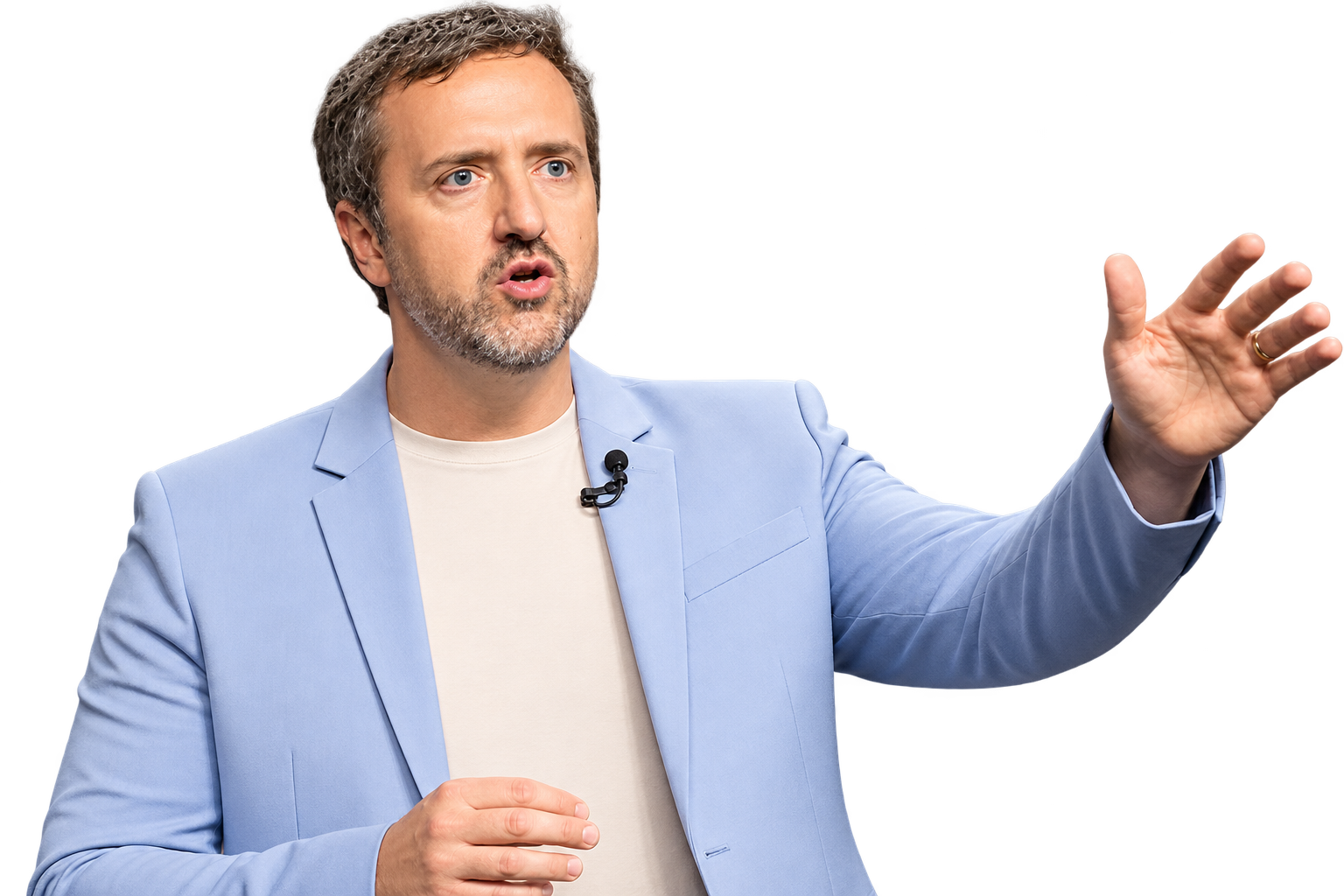
Vocal Leadership reads voice, breath and body as biomarkers of the nervous system under pressure, and works with the body to restore the signal.
Like every mammal, we read each other’s nervous systems through breath, body and voice. Under pressure the neck shortens, the ribs stop moving, the voice tightens and the body braces. These are called biomarkers of fight or flight, and when they activate, the strategy may be brilliant, but the message may no longer lands. This is the missing link between strategy and impact. Most leaders have never trained for it, because until recently there was no method that treated it as physiology rather than performance.
1. Have you left a decisive room knowing the thinking was right, and that it somehow did not land?
2. Under pressure, do you find yourself pushing harder, faster, more insistent, and getting less?
3. Has anyone described you as harder-edged, more distant or less decisive than you intended to be?
4. Do you accommodate in conversations where you had every intention of holding firm?
5. Does your voice tire, thin or flatten across a day of consequential meetings?
6. When the stakes rise, do your options seem to narrow to the ones you have always taken?
7. Can you tell the difference between presence you performed and presence you actually had?
If any of these are familiar, the issue is almost never the message. It is the state it is being delivered from.
HARVARD BUSINESS REVIEW
5 Techniques to Build a More Powerful Speaking Voice
by Albrecht Enders and Robin de Haas
Summary. In an era where the human elements of leadership matter more than ever, mastering your “vocal presence” isn’t just an enhancement to executive capability—it’s an essential dimension of how you inspire, connect with, and mobilize others toward shared goals. Through conscious practice of breath coordination and vocal techniques, you can develop a more commanding, authentic, and engaging presence that will resonate deeply with your audience. The article outlines five simple, functional exercises to improve vocal presence.
Selected as Tip #5 in Management Tips 2026, published in hardcover by Harvard Business Review Press.

WORLD ECONOMIC FORUM
Beyond breathing: How regulating your nervous system helps leaders have impact, according to an expert
You can have the best strategy and still have little impact. Voice and body are the missing link between strategy and the effect of that strategy. »

Our methodology
How it works
Read: We read voice, breath and body language as biomarkers of how the nervous system responds under pressure.
Release: We work with the fight-or-flight patterns that limit the leader’s freedom to choose.
Reorient: We reconnect the leader with their core purpose, and use it as the lens through which to assess choices.
Reassess: As the leader reconnects with purpose, the nervous system sends different signals, increasing decisiveness, direction and clarity.
How we measure it
Every journey opens with each leader recorded under genuine pressure in front of their own team, not in a workshop exercise and assessed on breath, resonance, modulation and clarity alongside body, stillness and command.
That becomes a confidential baseline report and a set of scored KPIs. At the close, a second recording is assessed against the same measures. The shift is evidenced rather than described.
Why it matters
Voice is not simply sound. It is one of the ways the nervous system communicates how we are relating to the people in front of us.
Under pressure, ingrained relational patterns become audible. We seek approval, accommodate, withdraw, push, or protect ourselves, and we do none of it deliberately.
Correcting the voice artificially masks these signals and disconnects expression from relationship.
Vocal Leadership does the opposite: it reads them, releases the protective patterns that limit choice, and reconnects the leader with what they actually stand for. Decisiveness, direction and clarity then stop being performed. They are communicated.
Traditional voice coaching asks: How can I sound more authoritative?
Vocal Leadership asks: What needs to change so that authority no longer needs to be performed?
Trusted by
Delivered to senior leaders and executive teams at institutions where decisions are made under scrutiny.


In their words
Robin helped me build on my personal strengths and values, encouraging me to lead in a way that feels authentic. Through his work on executive presence and voice leadership, he helped me become more present, more self-confident, and more intentional in how I show up as a leader.
Robin has a unique ability to listen deeply, ask powerful questions, and help bring clarity and authenticity to complex ideas. His coaching style is thoughtful, practical, and deeply human. He creates a safe space while also challenging you to communicate with more confidence and impact. His guidance for my TED talk helped me refine my message, connect more strongly with my story, and deliver it with greater purpose. I highly recommend Robin to leaders and professionals looking for a coach who brings clarity, presence, and genuine insight.
Robin De Haas brings a rare ability to strengthen one of the most critical capabilities of executive leadership authentic influence. His expertise in executive presence and vocal leadership enables senior leaders to communicate with greater clarity, credibility, and confidence, particularly in high stakes environments where leadership presence directly shapes outcomes.
Robin has a rare ability to see and unlock what lies beneath the surface. His gift for identifying what’s holding your voice back, and helping you release it, feels almost disarming, and it’s a reaction I heard echoed again and again across our group. Even now, I’m continually struck by what others share after meeting him the impact he has on people is remarkable to witness. I left not only with practical tools, but with real clarity and a renewed connection to my own voice and sense of purpose.
What stays with me most is his combination of skill and kindness. He creates the kind of safe, honest space where change actually happens. I came away feeling genuinely changed and grateful. If you have the chance to work with Robin, take it! Few people leave such a lasting mark.
Contact
use the contact form or contact us directly by e-mail : admin@vocalleadership.com
Meet the team
Vocal Ledership Founding Faculties are hand picked by Robin to help bring the work worldwide
Ariane Leanza Heinz
Is a vocal coach, music manager, and Vocal Leadership faculty member. She has over 20 years of experience guiding artists, professors, and leaders at organisations like Google, TEDx, ETH or Disney Research. Born with a hips dysplasia, Ariane found hope in the story of Robin de Haas, seeing how he overcame his own handicap to help others shine. This discovery redefined her purpose, inspiring her to dedicate her life’s work to helping others break through their own physical and physiological barriers. Today, she delivers the Vocal Leadership program to empower global executives to conquer hidden limitations, align their presence, and lead with ultimate impact.

Wyna Giller
A vocal coach and Vocal Leadership faculty member, Wyna brings together expertise in social sciences, performing arts, vocal training, and MDH Breathing Coordination to explore the profound connection between voice, embodiment, leadership, and purpose. She is deeply convinced that our greatest contribution begins with taking responsibility for what we bring into the world. Wyna helps leaders reconnect with what truly matters to them and express it authentically through how they communicate, connect, and lead.

Darel Evans
Darel Evans is an MDH Vocal Leadership educator and the founder of Prehab Performance Specialists; whose work sits at the intersection of physiology, voice, and purpose. From military service to healthcare, his path is driven by a belief that meaningful leadership begins with connection. As part of the MDH Vocal Leadership Faculty, he helps people reclaim their voice, reconnect with what matters, and shine in the spaces where they lead.

Elodie Romand
Is a Vocal Leadership faculty member and vocal coach who is drawn to any context where she can help people unlock their potential and reveal the unique gem they are to the world. With experience in both opera and the corporate sector, she understands that the voice touches something so deep and authentic within us. Passionate about both performance and teaching, Elodie is dedicated to creating spaces where leaders and artists can forge purposeful connections and share their gifts without interference, helping them bring their fullest selves to how they communicate and lead.

Moyli Tan
Passionate about how the brain works, I trained as a neuropsychologist and speech-language pathologist, building expertise across clinics, schools, and private practice — in cognitive evaluation, voice treatment, and manual therapy. But it was Breathing Coordination MDH, discovered in 2017, that changed everything a methodology that finally connected body and brain. That was an inner revolution — and it still drives me, in my work and in my everyday life. Today, I’m a Master Practitioner and Vocal Leadership faculty member.
Copyright © MDH VOICE AND BREATH SOLUTIONS Sàrl. All Rights Reserved.
Powered and hosted by ServerProject. This site is protected by reCAPTCHA and Google Privacy Policy and Terms of Use.